

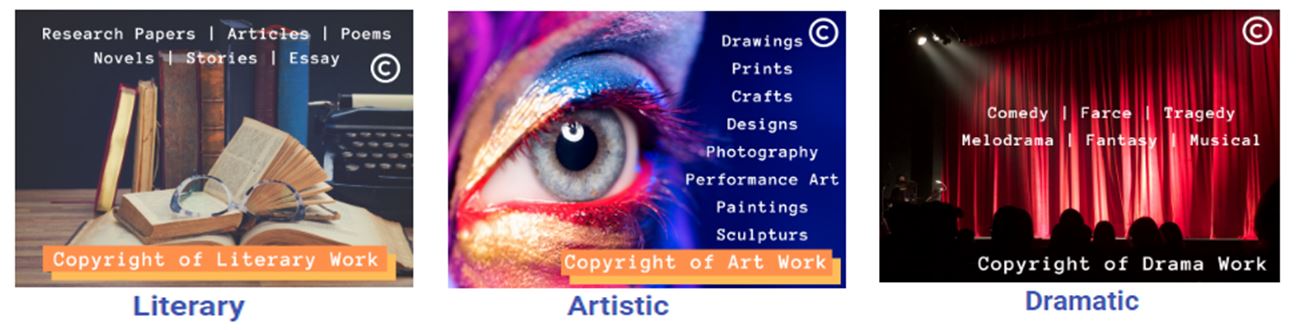
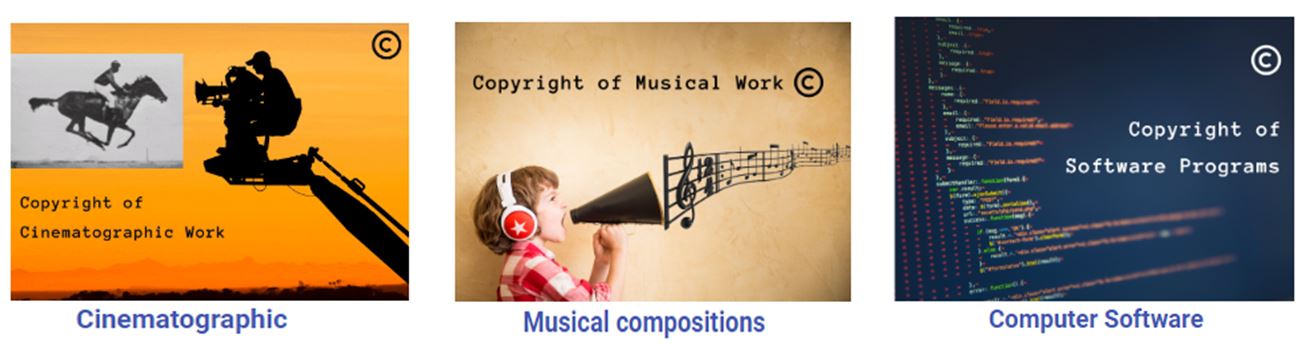
Copyright is a right to copy. Copyright is associated with the protection of works such as literary artistic work, dramatic, Cinematographic work, sound recordings, photographic work, and musical composition ,etc. Copyright is a bundle of rights. The rights conferred to the owner of the works are:
• Right of reproduction
• Right to publish
• Right to Broadcast
• Right to prevent others from using the works
Copyright
OVERVIEW

Works protected by Copyright
An applicant must see as to: what should be protected and how to make the protection process financially viable and sustainable for the producers? whether there is consensus among the stakeholders of GIs as to the method of production and area of production? Actually, the applicant must recognize and follow those procedures that would benefit all GI stakeholders. Post-registration, it is important to keep track of violations and keep a constant market check to ensure quality control. Contact GI Registry at the following Address: Geographical Indications Registry Intellectual Property Office Building, G.S.T Road, Guindy, Chennai – 600 032. Phone No: 044- 22502091 / 92 Fax Number: 044-22502090 E-mail: gir-ipo@nic.in Website: http://ipindia.nic.in/girindia/
History
It goes back when in Rome there were book sellers with a set of trained slaves who used to transcribe the manuscript and make copies of the books and sell. Sometimes the author was paid but there was no mention of copyright.
The history of copyright starts with early privileges and monopolies granted to printers of the book. Initially, Copyright law only applied to the copying of books.
Over the time other uses such as translations and derivative works were made subject of copyright and thus copyright now covers a wide range of works including maps, performances paintings, photographs, sound recordings, motion pictures and computer programs.
Notices
Notice of Copyright:
The copyright protection for literary work is represented as ©(the encircled letter “C”).
The copyright protection given for the sound recordings of musical or other audio works is represented as encircled “P”.
“All rights reserved” is the normally coined term for copyright protected works.
International Treaties
There are two primary international copyright agreements:
- The Universal Copyright Convention
- The Berne Convention
- The Rome Convention
- TRIPS agreement
- WIPO Copyright treaty
- WIPO Performances and Phonograms Treaty
World’s first copyright law was the statute of Anne, 1710 in England. This act for the first time rewarded the work of author a fixed term of copyright protection. Legislation based on the statute of Anne appeared gradually in other countries but there was no uniformity among all these until the 19th century. In 1886, Berne convention was introduced which provided a framework of international standards for copyright protection. It provided basis for international copyright law and Berne Convention lifted copyright protection beyond territorial borders i.e. Under Berne Convention, each member state recognizes the copyright of authors from other member states in the same way as the copyright of its own nationals, which is called as National Treatment.
India joined Berne Convention on April 1, 1928.
In India, the First Copyright act enacted in 1957 which was applicable from 21st January 1958. This law has been amended six times since 1957. The recent amendment was in the year 2012.
Term of the Copyright in India – lifetime of the author + 60 yrs. after the death of the author.
Copyright prosecution in India is a comparatively easy, fast and economical process. Although the copyright protection starts from the moment it is created, it is recommended to have a legal protection by registration of the work under copyright act of India.
Often people confuse copyright with patent. Unlike patent which is related to problem-solution approach, Copyright is related to the expression of idea. Aim of Copyright protection is to promote culture, Science and arts. This is done by granting the creators of works a bundle of rights. This enables them to control reproduction of their work without their consent.
You must have seen © in many books. Copyright is an exclusive right given to the author or owner of the creative work. Copyright is intended to protect expression of the idea and not the ideal itself and hence two different people can have copyright protection for the same idea.